

Ripple is expanding the infrastructure around its U.S. dollar-backed stablecoin RLUSD, even as monthly transfer volume has fallen to around $11 billion. With the number of holders rising while transaction activity slows, attention is shifting toward a broader question: how can crypto holders make more practical use of their digital assets?
Ripple has taken two notable steps to expand the institutional infrastructure surrounding RLUSD.
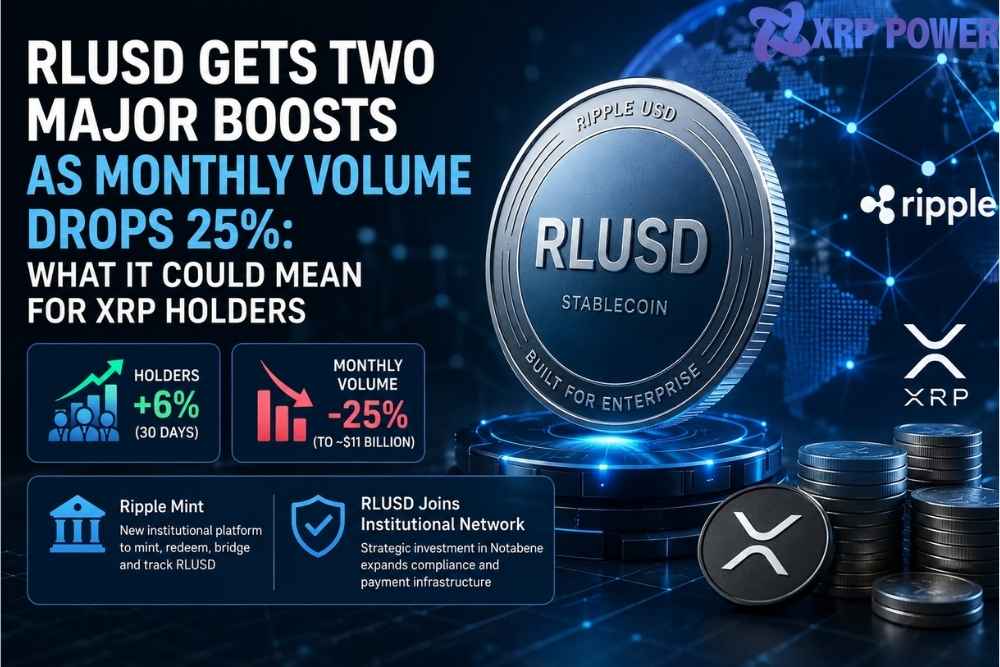
The company introduced Ripple Mint, a platform designed to help institutional clients create, redeem, bridge and track RLUSD through a web interface or direct system integrations. The move could make it easier for businesses to manage RLUSD without relying on more manual issuance processes.
At the same time, RLUSD has been expanding beyond the XRP Ledger and Ethereum into additional blockchain networks, increasing the number of environments where the stablecoin could potentially be used.
Ripple has also strengthened RLUSD’s connection with institutional compliance and payment infrastructure, another sign that the company is focusing on practical adoption rather than simply increasing token supply.
But recent market data reveals an interesting contrast.
RLUSD Holders Are Growing, but Transaction Volume Is Falling
RLUSD has grown into one of the larger regulated dollar-backed stablecoins, with a market capitalization of roughly $1.5 billion.
Over the past month, the number of RLUSD holders increased by around 6%, while active addresses climbed approximately 70%.
Those numbers suggest that more users are entering the ecosystem.
Transaction activity, however, has moved in the opposite direction.
Monthly transfer volume declined by roughly 25%, falling from about $14.6 billion to around $11 billion. Market capitalization also decreased by nearly 5% during the same 30-day period.
The result creates an important distinction: more wallets are holding RLUSD, but the assets are moving less frequently between them.
That raises a broader question that extends beyond RLUSD.
As XRP, Bitcoin, Ethereum and stablecoins become part of more individual and institutional portfolios, what can holders do with digital assets they are not currently planning to sell?
Crypto Investors Are Looking Beyond Simply Holding
For years, one of the most common crypto strategies was straightforward: buy an asset, hold it and wait for its market value to increase.
That strategy remains popular, but it depends heavily on market conditions.
During strong markets, long-term holders can benefit from rising prices. During sideways or declining periods, however, digital assets may remain inactive in wallets or exchange accounts for extended periods.
The divergence between RLUSD holder growth and declining transfer volume highlights this issue from another angle.
As a result, some digital asset holders are exploring staking, lending, cloud computing and automated asset-management models as potential ways to use crypto differently rather than relying exclusively on short-term price movements.
This broader shift is also where XRPPower is positioning its digital-asset services.
XRPPower Explores a Different Approach for Digital Asset Holders
XRPPower focuses on digital assets and cloud-computing services, offering different plans aimed at users interested in exploring alternative ways to utilize assets such as XRP, BTC and ETH.
Rather than focusing solely on buying low and selling high, the concept is built around giving users access to different service periods and participation options based on their own capital, objectives and risk tolerance.
For XRP holders in particular, the timing is notable.
Ripple continues to expand the infrastructure surrounding XRP Ledger and RLUSD, while institutional adoption remains one of the central themes surrounding the ecosystem.
For individual holders, however, the question is often much simpler:
Should digital assets remain in a wallet, be actively traded, or be used through other crypto-based services?
There is no single answer that works for every investor.
But the conversation around crypto is gradually moving beyond the question of how high XRP, Bitcoin or Ethereum could trade. Increasingly, attention is turning toward how digital assets can be used in real-world financial and digital infrastructure.
From Holding Digital Assets to Finding Practical Utility
Ripple Mint, RLUSD’s expansion across blockchain networks and its growing institutional infrastructure all point toward the same long-term objective: creating more ways for digital assets to function within real financial systems.
A 25% decline in RLUSD’s monthly transaction volume does not tell the entire story. Growth in holders and active addresses suggests that interest in the stablecoin continues to expand, even if actual capital movement has slowed.
The next stage of RLUSD’s development may therefore depend not only on how much of the stablecoin exists, but on how frequently businesses and users actually use it for payments, settlement and other financial activities.
The same question increasingly applies to XRP, BTC and ETH holders.
As digital assets evolve from speculative instruments toward broader financial tools, asset utility could become just as important as price performance.
Users interested in learning more about cloud-computing models and alternative approaches to digital asset utilization can explore XRPPower’s official website to review how the platform works, available plans, applicable fees, terms and potential risks before deciding whether any service is appropriate for them.
Disclaimer: This is a sponsored press release for informational purposes only. It does not reflect the views of Times Tabloid, nor is it intended to be used as legal, tax, investment, or financial advice. Times Tabloid is not responsible for any financial losses.

