


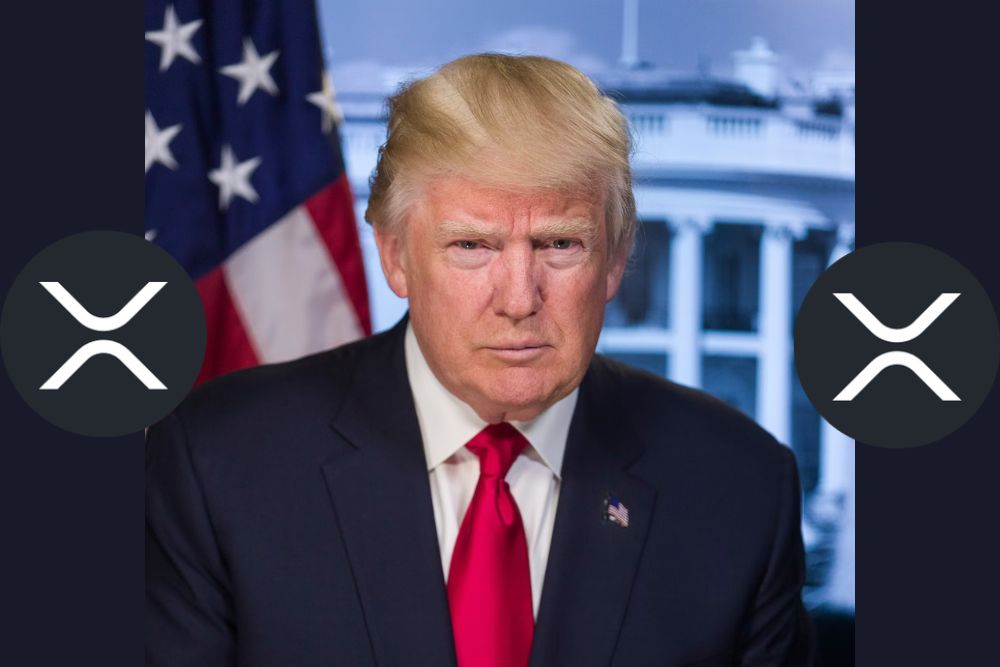
A fundamental shift is unfolding in the intersection of economic policy, global trade, and digital finance. As geopolitical strategies, tariff dynamics, and capital flows reshape commerce, financial infrastructure must evolve to handle surging cross‑border liquidity needs.
Millions of businesses expanding supply chains and erecting new facilities across the United States demand faster, more efficient payment systems. Hence, digital assets, once relegated to speculative narratives, are now entering strategic conversations about the future of settlement and liquidity.
In a provocative post on X, financial commentator X Finance Bull highlights this changing landscape and suggests that President Donald Trump’s economic agenda could inadvertently elevate XRP’s role in U.S. financial plumbing.
During a recent NewsNation interview, Trump outlined the unprecedented scale of capital moving into America as a byproduct of tariff‑induced investment. “So we have thousands of businesses being built right now because of tariffs, so all over the world they’re coming, and they’re building car plants, AI plants…” Trump said, emphasizing that the inflows — approaching $18 trillion — signal a surge in economic activity unlike anything seen before.
“We’ve never had anything like eighteen trillion,” he added, framing this as a historic wave of commercial growth.
BOOM 🚨🚨🚨 What Trump Is Planning Will Need $XRP 👇
$18 trillion is not just money coming into America. IT IS PRESSURE!
Pressure on banks, payroll systems, FX rails, and settlement speed.
President Trump just said in a recent interview that factories, AI plants, and… pic.twitter.com/VjzBJ3wIbj
— X Finance Bull (@Xfinancebull) January 22, 2026
Economic Expansion and Payments Pressure
President Trump’s remarks reflect more than optimism; they point to a structural reality. Businesses relocating or expanding operations trigger significant cross‑border payments, foreign exchange conversions, and liquidity allocations.
Traditional financial rails like SWIFT and correspondent banking systems were not built for real‑time settlement at this scale. They often require pre‑funded accounts, lag settlement by days, and incur substantial fees. As global capital re‑routes into American industries, the friction inherent in these legacy systems becomes a bottleneck.
Financial observers argue that solving this bottleneck requires infrastructure capable of instant settlement and dynamic liquidity provisioning — precisely where blockchain solutions shine. In particular, XRP, native to the XRP Ledger, enables near‑real‑time cross‑border settlements with minimal cost and friction.
XRP’s consensus algorithm processes transactions in seconds with settlement finality that contrasts starkly with the multi‑day cycles of legacy systems. This efficiency becomes critical when payment volumes escalate due to macroeconomic shifts and tariff‑driven relocations.
We are on X, follow us to connect with us :- @TimesTabloid1
— TimesTabloid (@TimesTabloid1) June 15, 2025
XRP’s Utility and Strategic Fit
Ripple’s On‑Demand Liquidity (ODL) service leverages XRP as a bridge asset. This eliminates the need for pre‑funded nostro/vostro accounts and reduces liquidity costs significantly in high‑volume corridors.
Institutions using ODL convert local fiat to XRP, settle across borders within seconds, and convert back to destination fiat, streamlining value transfer and minimizing capital lock‑ups. This real‑time liquidity model aligns with corporate treasury demands and large‑scale commercial activity.
Beyond payments, regulatory progress has bolstered XRP’s institutional narrative. The resolution of Ripple’s SEC lawsuit has catalyzed institutional interest and cleared pathways for compliant products and partnerships.
This legal clarity, alongside developments like RLUSD stablecoin integration and prime brokerage initiatives on the XRP Ledger, strengthens XRP’s appeal as infrastructure rather than speculation.
Policy, Regulation, and Strategic Adoption
Conversations about a U.S. Crypto Strategic Reserve that include XRP alongside assets like Bitcoin and Ethereum reflect a broader governmental acknowledgment of digital asset utility in strategic finance.
Trump’s executive directives and subsequent legislative efforts, like the emerging Clarity Act, aim to formalize crypto’s role in national economic frameworks. Reports show that such initiatives could pave the way for digital assets to support treasury functions, liquidity buffers, and cross‑border settlements at scale.
Infrastructure Before Headlines
Trump’s economic blueprint creates immense pressure on payments, FX, and settlement infrastructure — pressure that legacy systems struggle to absorb. XRP’s design as a bridge currency and its growing institutional footprint position it as a candidate to address these needs. As X Finance Bull notes, demand follows plumbing, not headlines.
In an era defined by rapid capital flows and strategic economic realignment, digital settlement rails like XRP could shift from peripheral interest to central utility in modern finance.
Disclaimer: This content is meant to inform and should not be considered financial advice. The views expressed in this article may include the author’s personal opinions and do not represent Times Tabloid’s opinion. Readers are urged to do in-depth research before making any investment decisions. Any action taken by the reader is strictly at their own risk. Times Tabloid is not responsible for any financial losses.
Follow us on Twitter, Facebook, Telegram, and Google News

