

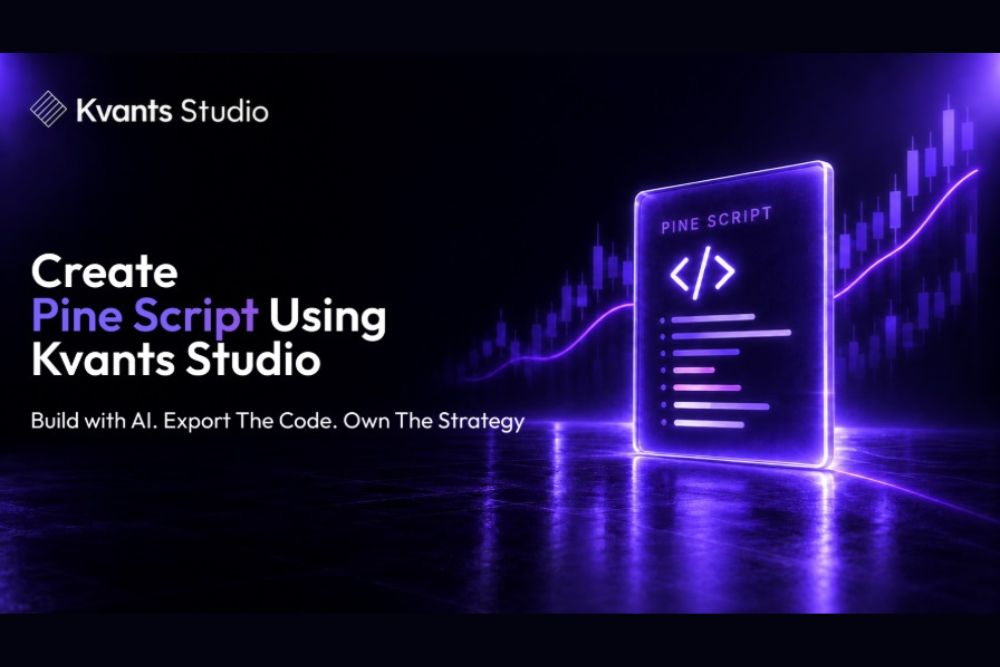
AI trading platforms often make strategy creation easy and portability difficult. Kvants Studio is an AI trading strategy builder from Kvants for creating, editing and backtesting strategies, then exporting compatible results as Pine Script or JSON. This lets traders move their work into external trading tools instead of leaving it locked inside one platform.
Can an AI-generated trading strategy be exported to TradingView?
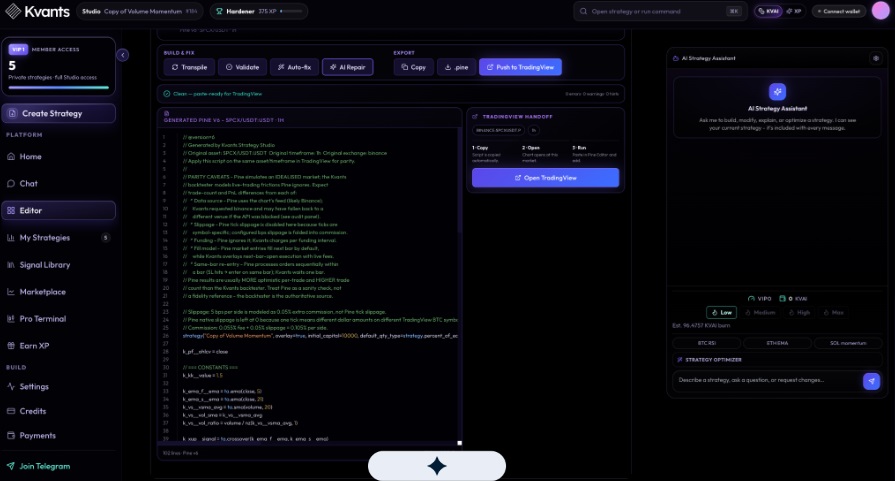
AI-generated strategies can be exported when a platform converts indicators, conditions and risk rules into Pine Script that TradingView can execute. Kvants Studio supports Pine Script v6 exports for compatible strategies, allowing users to move from a plain-English idea to editable code rather than leaving the result inside a closed interface.
What does a Pine Script v6 strategy export contain?
A complete strategy export should include its indicators, entry and exit conditions, position sizing, stop and target rules, and modelled fee and slippage assumptions. Kvants says its supported exports do not call back to the platform. Each export also includes a parity note explaining why TradingView results may differ from the original backtest because of data feeds, funding costs or fill timing.
That distinction matters. Portable code does not guarantee identical results or future returns, but it gives the trader something concrete to inspect, modify and reuse. Company-reported beta data shows that more than 200 active users produced over 1,700 Pine Script exports, suggesting that users often repeated the cycle of building, checking and revising strategies.
Can traders inspect and modify an AI-generated strategy?
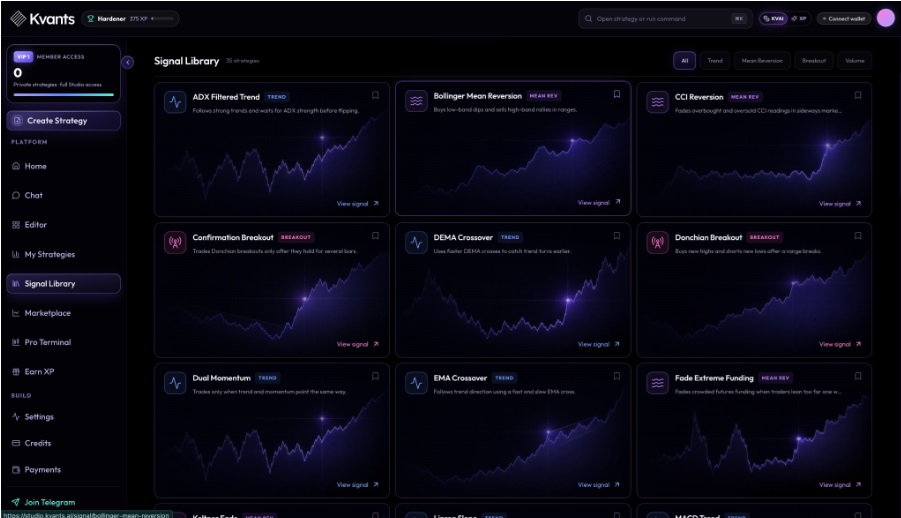
Kvants Studio represents each generated strategy as an editable visual graph rather than a fixed AI response. Traders can review individual nodes, change thresholds, challenge rules or build from scratch. The system draws on global reference strategies and a 57-signal in-house library maintained by quantitative and high-frequency trading practitioners with experience at Citigroup, J.P. Morgan and Kraken.
The purpose of this visibility is not to make every strategy valid. It is to help users understand exactly what will be exported and avoid treating the AI’s first answer as a finished trading system.
How should an AI trading strategy be tested before use?
An AI trading strategy should be tested on data and conditions it was not optimised against. That means combining historical simulation with modelled trading costs, anti-lookahead protection, out-of-sample analysis, walk-forward testing, parameter sweeps and stress scenarios.
Kvants Studio uses an event-driven backtesting engine and requires a stop-loss. Its configurable risk gate reviews deployment rules and explains why a setup does not pass. Paper trading can then expose the strategy to live market movement without committing capital. None of these steps proves that a strategy will be profitable, but together they can reveal assumptions that a headline return may conceal.
Why does portability matter in an AI trading platform?
Portability matters because a strategy locked inside one interface creates long-term dependence on that interface. An exportable strategy makes the platform earn continued use through research quality and workflow—not through technical lock-in.
For traders evaluating AI tools, the practical ownership test is simple: Can the strategy be understood, independently tested, edited and taken elsewhere? If the answer is no, the user may own the account without truly owning the strategy.
About Kvants
Kvants builds Kvants Studio, an AI trading strategy builder for creating, editing and backtesting strategies, with compatible exports available as Pine Script or JSON for use in external trading tools.
Kvants Studio is a research and simulation tool, not investment advice. Trading involves risk, and hypothetical results may not reflect live execution.
Disclaimer: This content is meant to inform and should not be considered financial advice. The views expressed in this article may include the author’s personal opinions and do not represent Times Tabloid’s opinion. Readers are advised to conduct thorough research before making any investment decisions. Any action taken by the reader is strictly at their own risk. Times Tabloid is not responsible for any financial losses.

