


Trading futures opens the door to earning significant returns, but it also involves higher risk. The crypto futures market processes hundreds of billions of dollars in volume every month, and countless exchanges now offer futures products. However, not all platforms are equal when it comes to leverage, liquidity, fees, and security. This Bitunix review looks at futures trading on Bitunix and Bitget, two leading centralized exchanges for trading leveraged Bitcoin, Ethereum, Solana, and a wide range of altcoins.
In simple terms, futures allow traders to speculate on price movements without owning the underlying asset. For example, trading BTC-USDT futures enables a trader to profit from both rising and falling Bitcoin prices using leverage.
Choosing the right futures platform is critical. Execution quality, fee structures, leverage limits, and risk management tools can all materially impact long-term profitability.
This article provides a clear evaluation of the Bitunix and Bitget futures trading experience, helping traders decide which platform better suits their needs.
Crypto Futures vs. Spot Trading: What’s the Difference?
Crypto futures trading allows traders to speculate on the future price action of an asset, often using leverage. This unlocks the ability to profit when prices move up or down, while also multiplying potential gains and losses. Futures contracts do not require ownership of the underlying asset; instead, traders are taking a position on price direction.
Spot trading, by contrast, involves buying and selling the actual cryptocurrency. When you purchase an asset on the spot market, you own it outright and can hold, transfer, or use it within the broader crypto ecosystem. Spot trading is generally considered lower risk because it does not involve leverage or liquidation thresholds.
Futures trading enables advanced strategies such as hedging, shorting, and capital-efficient exposure. On Bitunix, users can trade futures across hundreds of pairs with leverage of up to 200x. While this creates the potential for significant returns, it also introduces liquidation risk, making futures trading better suited to experienced traders who understand margin and risk management.
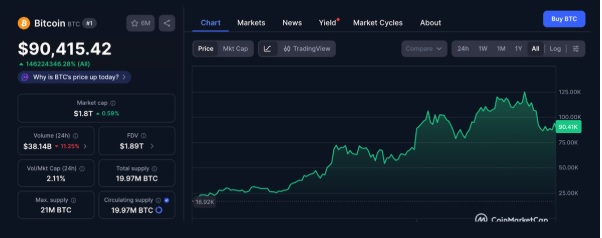
Bitcoin price chart. Source: CoinMarketCap
Crypto Futures Trading on Bitunix
Bitunix has built a global user base with over three million traders, many of whom rely on the exchange daily for futures markets. The platform is designed to make futures trading as simple and accessible as possible across hundreds of different pairs, including highly liquid markets such as BTC-USDT, as well as a wide range of altcoin futures for traders seeking additional volatility.
Bitunix offers three different types of futures contracts. USDT-M futures are settled in USDT, USDC-M futures are settled in USDC, and Coin-M futures are settled directly in cryptocurrency. This gives traders flexibility depending on their preferred collateral and settlement method.
Leverage is a key strength of Bitunix. Selected futures pairs support leverage of up to 200x, allowing traders to maximize capital efficiency, while also increasing liquidation risk if positions move against them.
The platform features a competitive fee structure with VIP tiers that reduce maker and taker fees for high-volume traders, making it attractive for frequent futures activity. In addition to this, there are no deposit fees on SEPA transfers for EU clients, adding an additional incentive for EU-based crypto futures traders.
Security is reinforced through public Proof of Reserves that can be checked at any time through the website and the Bitunix Care Fund, a dedicated protection reserve designed to safeguard user funds, holding $30 million in USDC.
Overall, Bitunix futures are well-suited to experienced, high-frequency, and professional traders who prioritize leverage, liquidity, and transparency.
Bitget Futures Explained
Bitget is a major crypto exchange that has established its position in the market with a solid spot trading offering alongside tools such as staking, copy trading, and futures. According to its official website, Bitget supports over 600 futures trading pairs, covering most major assets while also providing access to lesser-known altcoins that often generate significant returns due to higher volatility.
Bitget futures benefit from strong liquidity on major perpetual contracts such as BTC-USDT and ETH-USDT. The platform supports perpetual futures with competitive leverage limits, making it suitable for both directional traders and hedging strategies.
Copy trading is a core component of the Bitget ecosystem and one of its strongest differentiators. Users can follow experienced traders and automatically mirror their futures positions directly from the platform.
Overall, Bitget is a solid futures trading platform. However, Bitunix arguably offers a stronger fee structure through its VIP system, a more comprehensive interface, and an additional layer of protection via the Bitunix Care Fund.
Final Thoughts: Bitunix vs. Bitget Futures
Both Bitunix and Bitget provide strong options for futures traders. Using these platforms, traders can access hundreds of trading pairs, and with Bitunix, they can trade with up to 200x leverage, making it possible to generate significant returns if positions are managed correctly. Overall, Bitunix arguably has more to offer than Bitget due to its higher leverage, more refined trading interface, and the Bitunix Care Fund, which provides an added layer of security and peace of mind for users.
Disclaimer: This is a sponsored press release for informational purposes only. It does not reflect the views of Times Tabloid, nor is it intended to be used as legal, tax, investment, or financial advice. Times Tabloid is not responsible for any financial losses.

