

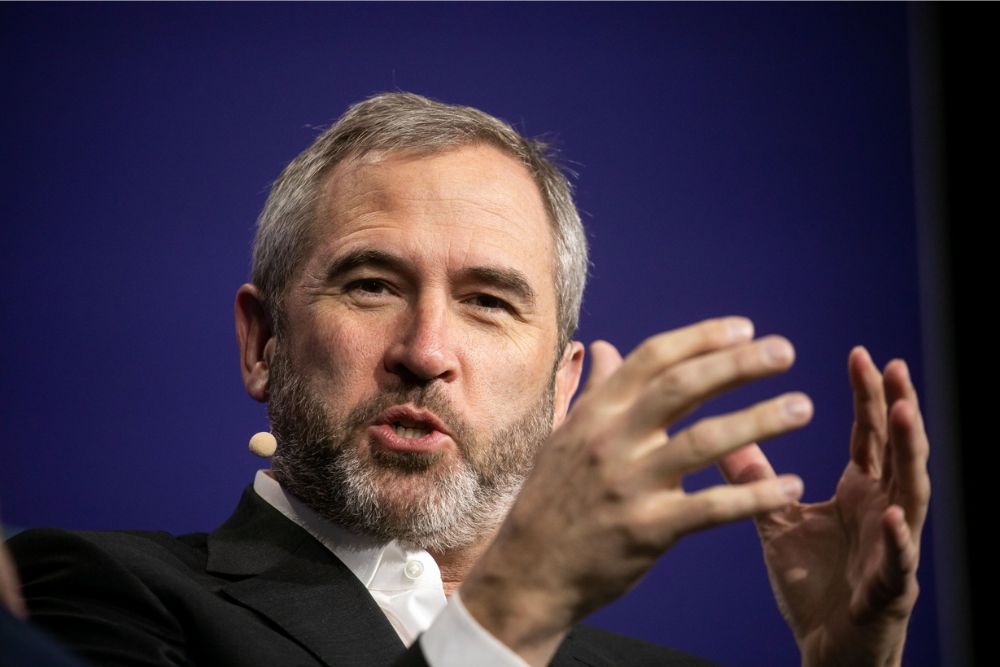
In a recent CNN interview, Ripple CEO Brad Garlinghouse laid out a bold vision for the future of global payments.
He said, “XRP is like a Bitcoin. It’s a digital asset. It’s today the third most valuable digital asset. And what we do is we take a transaction between banks.” His remarks have reignited discussion across the crypto and financial world about XRP becoming a foundational instrument for cross-border settlement.
Lord XRP, via a post on X, shared key quotes and insights from Garlinghouse’s interview — highlighting how XRP’s speed, liquidity, and technical design offer banks and payment providers a real alternative to legacy correspondent banking.
From Correspondent Banking to Real-Time Liquidity
Garlinghouse explained the inefficiencies of traditional banking:
“Instead of having a bank pre-fund an account at the other bank, which is how correspondent banking works today, the Bank of Brad in dollars would pre-fund the Bank of Julia, perhaps in pounds, and then I would debit and credit that. But that means I have to pre-fund and have dormant capital sitting at that other bank.”
Ripple’s solution allows financial institutions to tap directly into XRP liquidity, removing the need for pre-funding. Payments settle instantly, reducing costs and improving efficiency.
LISTENING TO BRAD GARLINGHOUSE ON CNN!! #RIPPLE IS ONE STEP AWAY FROM BECOMING A WORLD BANK!#XRP IS F***** CHEAP IN MY OPINION💥 pic.twitter.com/iggrgcue7F
— Lord XRP (@Bitforcoinz) December 10, 2025
Under RippleNet’s On-Demand Liquidity (ODL), a sending bank converts local currency into XRP, transfers it over the XRPL, and the receiving bank converts it back into the destination currency. The result: live cross-border settlement in seconds instead of days.
Massive Adoption: Institutions, Corridors, and Volume
As of 2025, RippleNet counts more than 300 banks and financial institutions across six continents. Garlinghouse highlighted real-world use cases: “The consumer itself doesn’t actually see that it’s flowing through XRP to solve a problem, but the consumer sees simply a better product at a better price.”
Major financial players such as Santander (Europe), SBI Holdings (Asia), and Standard Chartered (Middle East & global markets) use Ripple infrastructure. About 40 % of RippleNet partners actively use XRP for ODL-based settlements, with total processed value exceeding US$1.3 trillion in the first half of 2025.
Speed, Cost, and Technical Superiority
Garlinghouse emphasized XRP’s technical advantage: “Even compared to Bitcoin, which takes up to 12 minutes to complete one transaction, XRP is extremely fast at about three seconds per transaction. That has meant XRP is extremely scalable in contrast to how Bitcoin works.”
We are on X, follow us to connect with us :- @TimesTabloid1
— TimesTabloid (@TimesTabloid1) June 15, 2025
Fees remain negligible. Average XRP transaction fees are roughly US$0.0002, dramatically lower than traditional cross-border transfers. These features make XRP ideal for micropayments, remittances, and high-volume transfers.
Ripple’s Strategic Momentum and Growth Trajectory
Garlinghouse shared Ripple’s ambition: “We’re seeing more momentum than we’ve ever had around using XRP to move this liquidity around the world. We couldn’t really be happier about how that has played out in a world where there’s still a lot of uncertainty and doubt about what’s going on in crypto. This is a real use case solving a real problem for real customers.”
Ripple’s global footprint continues to grow. Partnerships with banks, launch of RLUSD, and acquisitions of corporate-crypto service firms signal strategic expansion. Within five years, Garlinghouse projects XRP could handle 14 % of cross-border payments volume currently dominated by SWIFT.
Real-World Challenges and Adoption Nuances
Despite growth, adoption remains uneven. Some banks use RippleNet for messaging only, without XRP as a bridge currency. Regulatory and risk management concerns may slow broader adoption.
Still, data show clear upward trends. Increased corridor launches, rising on-chain volume, and growing institutional usage suggest XRP’s integration into banking is accelerating.
In sum, Garlinghouse’s CNN statements highlight XRP’s transformation from a speculative token to a global liquidity bridge. Fast, low-cost, and scalable, XRP’s role in international banking may be closer than most expect.
Disclaimer: This content is meant to inform and should not be considered financial advice. The views expressed in this article may include the author’s personal opinions and do not represent Times Tabloid’s opinion. Readers are urged to do in-depth research before making any investment decisions. Any action taken by the reader is strictly at their own risk. Times Tabloid is not responsible for any financial losses.
Follow us on Twitter, Facebook, Telegram, and Google News

