
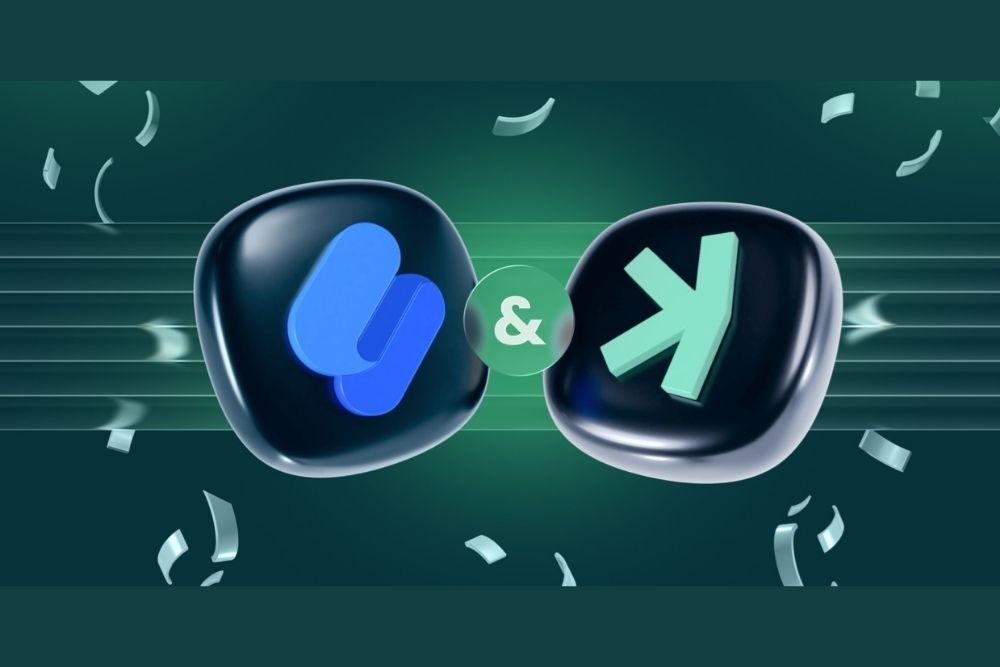
Three years of routing KAS, and what the largest liquidation cascade in crypto history confirmed about the layer nobody puts on a landing page.
This year marks three years since SimpleSwap began routing KAS. It is a modest anniversary by the standards of the category, and it is ours to celebrate rather than the network’s. Kaspa was under no obligation to make our job easier, and it did not.
We are marking it anyway because those three years changed how we work. KAS was never our biggest asset by volume. What it surfaced was an assumption we had carried since 2018, and fixing it changed the pricing logic that every other pair now runs on. In 2023, it seemed like a catalog edge case. Today, it feels like a preview of where the whole market is headed.
Here is why that matters to anyone embedding a swap. A user taps the swap button in your product. The estimate is off, or the funds take longer to arrive than the screen showed. They do not open a block explorer to figure out which layer failed them. They write to you.
That asymmetry defines the category. The question is not which provider has the longest asset list, but what job you are hiring someone to do.
The jobs a swap provider is hired for
Keep the promise I made on your behalf. Your interface shows a number before the user commits funds. That number came from an execution layer, but your product appears to be the one that said it.
Do not make me the one who has to explain. Every stalled swap turns into a support conversation somewhere. Whether it lands on your team depends on how clearly the provider shows what went wrong and how quickly a person steps in.
Be there on the worst day. Any provider looks competent on a calm day. The test is what happens when liquidity thins across the market at once, which is the day your users most want to move.
Do not turn integration into a permanent project. If every new asset becomes a ticket on your roadmap, you did not buy infrastructure. You bought an obligation.
Stress test one: a block faster than a price
KAS was one of our hardest exams, and the reason is structural.
An estimate is assembled from live quotes across venues that can fill the trade, weighted by the depth behind each one at that moment. It has a shelf life, because a quote from four seconds ago describes a market that no longer exists. On a slow chain, that shelf life comfortably exceeds the confirmation window, so the estimate survives the wait.
When we started routing KAS in 2023, Kaspa was producing about one block per second. The Crescendo hard fork in May 2025 raised that to ten. Settlement now happens faster than quote refreshes, which means the price your user agreed to can go stale within the very window it is supposed to hold, and the venue that looked best a moment ago may already be the wrong choice.
None of that is the network’s fault. What broke was an assumption inherited from a decade of slower rails: that the chain would always be the slow part.
Three years of rebuilding produced one portable lesson. An estimate is not a prediction about the market, it is a commitment with an expiry, and a system that does not track the age of its own inputs cannot honor it. Floating estimate accuracy on SimpleSwap now reaches 99.998% for the majority of swaps, and networks like this one are part of that.
“Fast chains did not get rid of latency. They just pushed it into a layer no one had ever measured, because there had never been a reason to measure it.”
Stefan Lauer, Head of Infrastructure, SimpleSwap
Stress test two: the day the depth disappeared
Speed is one way to break an execution layer. Removing its liquidity is the other, and the industry ran that experiment in public on 10 October 2025.
Roughly $19 billion in leveraged positions were force-closed within 24 hours across some 1.6 million accounts. Bitcoin fell by around 14% at its lowest, and several smaller assets briefly printed near zero as the order book ran out.
For anyone embedding a swap, the price move is not the main point. What matters is what broke underneath it. Reported outcomes included API failures and delayed deposits at a major exchange under heavy load, a well-known perpetuals venue offline for about eight hours, and another down for roughly four and a half. Synthetic dollar pricing detached sharply at one venue while holding near parity elsewhere, pointing to fragmentation rather than solvency.
Every one of those failures happened at the plumbing layer, and none were caused by a blockchain being slow.
That is the Kaspa argument arriving from the opposite direction. One event compressed the time available to quote, the other removed the depth behind it. In both, the chain performed as designed and the layer above decided what users experienced.
The structural issue lies in that fragmentation. When pricing on one venue breaks away from the rest of the market, a single-source route inherits the bad number. Aggregation across 20+ liquidity providers is what keeps one venue’s bad half-hour from becoming your user’s execution.
“You find out what an execution layer is worth on about four days per year. The rest is practice.”
Rick Cramer, Head of Analytics, SimpleSwap
Three questions to ask any swap provider
Throughput answers none of the jobs above. These do, and they work equally well pointed at us.
How old is the quote you are showing my users? A provider treating a four-second-old quote the same as a fresh one is guessing on your users’ behalf, and the guess arrives with your logo on it.
How many venues can a trade actually reach? Ask for the number of sources, then ask what happens when one stops quoting mid-route. Single-source execution looks identical to aggregated execution until the day it does not.
What does failure look like from my side? Every execution layer fails sometimes. What matters is whether your support team can see a stalled swap in real time and quickly reach a human.
What changes when fast becomes the default
Kaspa felt like an outlier when we integrated it. Now it reads as a preview. Sub-second finality is spreading across the category, and systems built for ten-minute settlement will meet the same constraints we ran into three years ago. We rebuilt for that on the network where the pressure was highest, and the volumes were modest, because what you learn from a demanding asset carries over to easier ones, and not the other way around.
So the anniversary is not really about an asset. It is about the year we stopped assuming the chain would wait for us.
Infrastructure check
| Metric | Value |
| Estimate accuracy, floating swaps | 99.998% for the majority |
| Liquidity providers under the hood | 20+, spanning CEX and DEX sources |
| Assets supported | 2,800+ |
| Trading pairs | 3.2M+ |
| Custody model | Wallet-to-wallet, no user balances are held on the platform |
| Support response, average | ~4 minutes, 24/7 |
| Partner products running the engine | 6,000+ |
| Operating since | 2018 |
SimpleSwap API integration is what those 6,000+ products already run on, including self-custody wallets, with no separate tier for demanding assets. Integration covers white-label or API-level swaps, revenue share on partner volume, asset coverage maintained on our side, and a named contact for incidents.
Disclaimer: This content is meant to inform and should not be considered financial advice. The views expressed in this article may include the author’s personal opinions and do not represent Times Tabloid’s opinion. Readers are advised to conduct thorough research before making any investment decisions. Any action taken by the reader is strictly at their own risk. Times Tabloid is not responsible for any financial losses.

