

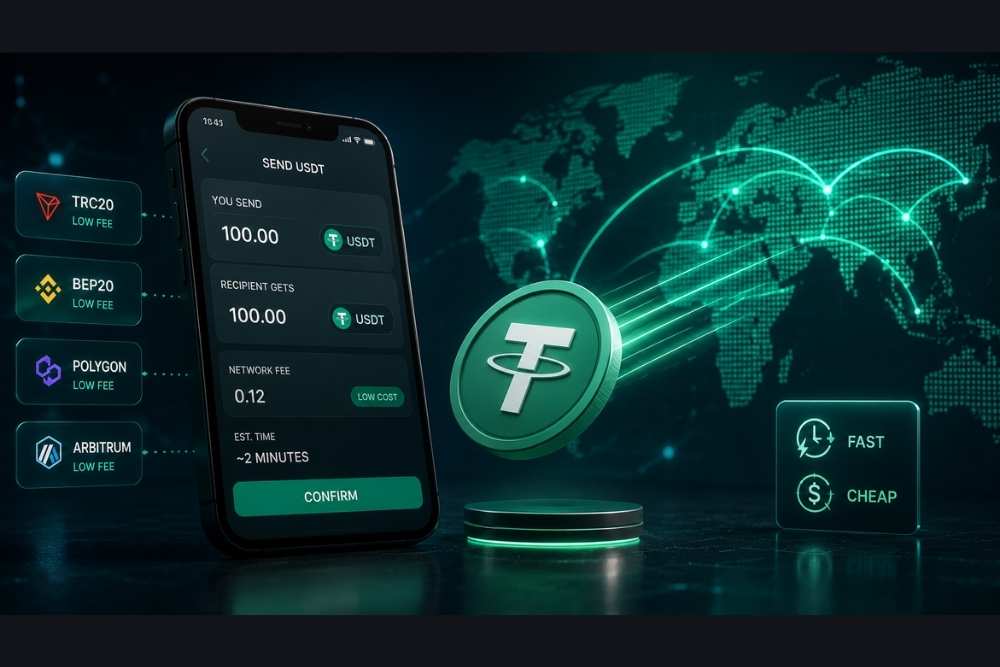
The same 100 USDT can cost a fraction of a cent to send, or more than twenty dollars. Nothing about the amount changes. What changes is the network it travels on and whether your wallet makes you buy a second token to move the first.
Cost lives in two decisions: which rail you send on, and how the fee gets paid. Get both right and USDT moves for almost nothing. Miss either one and you pay a premium for no benefit. Here is how to send USDT cheaply without guessing.
The Network Decides Most of the Cost
USDT is not one thing. It exists as separate tokens on separate blockchains, and the cheapest network for USDT is the single biggest lever on what a transfer costs, more than the wallet or the timing.
Tron carries the cheapest mainstream USDT. A TRC-20 transfer settles in about three seconds, and roughly half of all USDT supply now lives on Tron for exactly that reason. This is why most exchanges and traders default to Tron for moving USDT.
Ethereum is the opposite. An ERC-20 USDT transfer runs on gas priced by demand, and during busy periods, that fee can climb past twenty dollars for a single send. The token is identical; the rail is not.
BNB Chain and Solana sit in between, both cheap and fast, and both fine for USDT if your recipient accepts them. A multi-chain wallet makes the network easy to check before you send. Solana fees round to fractions of a cent, and BEP-20 transfers on BNB Chain rarely cross a few cents.
The rule is simple. Match the network to the recipient, and when you have a choice, choose Tron or Solana over Ethereum for a straight transfer.
The Second Token You Never Wanted to Buy
Here is where most people overpay without realizing it. To send TRC-20 USDT the old way, you need TRX in the wallet to cover the fee. Sending ERC-20 USDT instead means holding ETH. The stablecoin alone is not enough.
That requirement is the hidden cost. Someone holding only USDT has to go buy a second token first, usually from an exchange that verifies identity, just to move money they already hold.
USDT gas fees explained in one line: the fee is rarely the problem; the gas token you must acquire to pay it is.
Two paths avoid the trap. Stake the network’s resources so transfers cost almost nothing, or use a wallet that takes the fee from the USDT itself.
How to Skip the Gas Token Entirely
A growing set of wallets that skip the gas token now lets you send USDT without gas fees in the literal sense that no separate gas token is required. The fee comes out of the stablecoin you are sending, so USDT is the only asset you ever need to hold.
IronWallet is a non-custodial multi-chain crypto wallet with no KYC, 10,000+ supported assets, gasless stablecoin transfers, and WalletConnect Pay integration. It sends USDT on Tron with the fee deducted from the stablecoin itself, so a holder with nothing but USDT can move it without touching TRX.
As a gasless USDT wallet, it removes the exact step that traps newcomers.
Others reach the same result differently. Guarda charges a flat fee taken from the USDT on TRC-20 transfers, and Klever covers the Tron fee without a TRX balance.
TronLink lets you stake TRX for Energy, which drops per-transfer costs close to zero once you commit the capital. A 2025 cut to Tron’s energy price lowered the burn cost further. Each avoids the gas token; they differ in how.
What Actually Drives the Fee
Past the network choice, three smaller factors move the final number, and knowing them is how you stop overpaying.
- The gas token requirement. A wallet that makes you hold TRX or ETH adds a purchase step and its cost. A gasless wallet removes it. This is the difference that matters most for anyone trying to avoid high USDT transfer fees.
- Network congestion. Ethereum fees swing with demand, so an ERC-20 transfer that costs eight dollars at midnight can cost twenty-five at peak. Tron and Solana stay flat regardless of load.
- Staked resources. On Tron, staking TRX for Energy and Bandwidth can drive costs to near zero for frequent senders, though it locks capital up front and only pays off at volume.
The lowest USDT transfer fees come from combining a cheap network with a wallet that either abstracts the gas token or lets you stake around it.
TRC-20 vs ERC-20: Side by Side
The table shows why the network choice dominates every other factor. Figures are typical ranges and shift with demand.
| Rail | Typical fee | Gas token | Speed |
| USDT on Tron (TRC-20) | Under $0.01 to ~$1 | TRX, or none if gasless | Seconds |
| USDT on Ethereum (ERC-20) | $2 to $25+ | ETH | 1 to 5 minutes |
| USDT on Solana (SPL) | Fractions of a cent | SOL, tiny | Under a second |
| USDT on BNB Chain (BEP-20) | A few cents | BNB | Seconds |
Reading the TRC-20 vs ERC-20 fees row against each other tells the whole story. The same token costs a hundred times more on one rail than another, before the gas token is even considered.
Two Habits That Keep USDT Cheap to Send
The cheapest way to send USDT is not a secret trick. Send on Tron or Solana when the recipient allows it, and use a wallet that takes the fee from the stablecoin so you never buy a gas token.
Check the network before you confirm, since the address you paste locks in the rail.
A holder who moves USDT often, whether sending to friends or paying at retail, will find a gasless wallet on Tron, the closest thing to free. For someone tied to Ethereum by a counterparty, timing the transfer for off-peak hours is the main lever left.
For anyone sending across networks, confirm both sides accept the same one, since a mismatched rail loses the funds outright.
Conclusion
Sending USDT cheaply comes down to two habits: pick the right network, and hold a wallet that does not make you buy a second token to move the first. Tron and Solana keep the base cost near zero, and gasless wallets remove the gas-token step that quietly inflates the rest.
The token is the same everywhere. Its cost is a choice, and in 2026 an easy one to get right.
Frequently Asked Questions
Does the recipient pay any fee, or only the sender?
Only the sender. On every major network, receiving USDT is free, and the fee lands entirely on the person sending. This is why fee planning is a sender-side habit: the person paying chooses the network and the wallet, and therefore controls the cost. The recipient just supplies an address on a network they can access.
Why did sending to a brand-new wallet cost more than usual?
A first transfer to an address that has never held USDT costs roughly double, because the network initializes a token account for it. On Tron that is the difference between about 6 and 13 TRX. A gasless wallet like IronWallet folds this into the stablecoin fee; standard wallets pass it on. Sending a tiny test amount first activates the account.
What happens to the fee if my transfer fails?
You usually lose it. A failed transaction still consumes network resources, so the gas or energy spent is gone even though the USDT never moved. Failures often come from too little gas token or a wrong network selection. Confirming the network and keeping a small fee buffer prevents most failed sends before they cost you.
Is it cheaper to send one large transfer or several small ones?
One larger transfer, almost always. USDT network fees are charged per transaction, not by amount, so sending 1,000 USDT once costs the same as sending 100 USDT once. Ten separate sends pay the fee ten times. Batching payments into fewer transactions is one of the simplest ways to cut total cost.
Do other stablecoins cost the same as USDT to send?
Roughly, yes. Fees track the network, not the token, so USDC on Tron costs about what USDT on Tron costs, and both are far cheaper than either on Ethereum. The rule holds across stablecoins: the rail you choose sets the price, and the specific stablecoin barely moves it.
Disclaimer: This article is provided for informational purposes only. It is not offered or intended to be used as legal, tax, investment, financial, or other advice.
Disclaimer: This content is meant to inform and should not be considered financial advice. The views expressed in this article may include the author’s personal opinions and do not represent Times Tabloid’s opinion. Readers are advised to conduct thorough research before making any investment decisions. Any action taken by the reader is strictly at their own risk. Times Tabloid is not responsible for any financial losses.

