
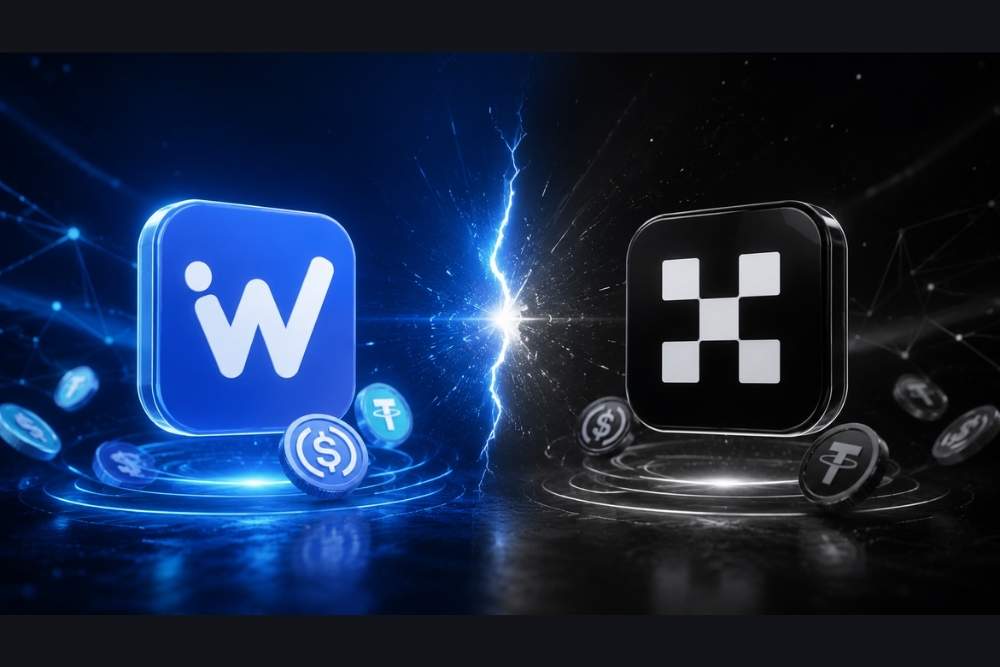
Two non-custodial wallets, two philosophies. OKX Wallet wants to be everything: a hundred-plus chains, a built-in exchange, staking, NFTs, and market data in one app. IronWallet wants to do one thing cleanly: hold and move stablecoins without friction or identity checks.
Both keep your keys on your device, and neither asks for KYC at the wallet level. From there, they diverge sharply, and the right pick depends less on which is better and more on what you actually do with stablecoins.
What Each Wallet Is Built For
OKX Wallet is a Web3 operating layer. It supports 130+ native chains and a built-in DEX aggregator that routes swaps across hundreds of venues and adds staking, an NFT marketplace, and on-chain discovery tools.
Reviews consistently call it one of the most capable wallets available, and just as consistently note it can feel crowded for anyone who only wants to send a payment.
- What it is: a full on-chain toolkit with swaps, bridging, staking, and NFTs built in.
- Best for: active users who live across many chains and want everything in one app.
- The catch: feature density that can overwhelm someone who only holds stablecoins.
IronWallet is a non-custodial multi-chain crypto wallet with no KYC, 10,000+ supported assets, gasless stablecoin transfers, and WalletConnect Pay integration. It covers seven networks built around where stablecoins actually live, and strips the interface down to holding, sending, and paying.
This is the core of any honest IronWallet vs OKX Wallet comparison: one wallet maximizes what you can do, the other minimizes what stands between you and a transfer.
- What it is: a focused stablecoin wallet with gasless transfers and no identity checks.
- Best for: holders whose main activity is receiving, keeping, and sending USDT or USDC.
- The catch: seven networks and mobile-first, by design, so power users wanting a hundred chains look elsewhere.
Chain Coverage and Stablecoin Support
On raw breadth, OKX wins, and it is not close. It supports Bitcoin, Ethereum, BNB Chain, Tron, Solana, Arbitrum, Base, Optimism, Polygon, Avalanche, and dozens more, with USDT and USDC across ERC-20, TRC-20, BEP-20, and SPL.
For someone holding fifteen assets across a dozen networks, that coverage removes the need for a second wallet entirely.
IronWallet covers seven networks: Bitcoin, Ethereum, Solana, BNB Chain, Tron, Polygon, and Base. Fewer, but chosen deliberately, since those seven carry nearly all live stablecoin supply.
As a best multi-chain stablecoin wallet contender, its argument is not breadth for its own sake, but reaching every network a stablecoin holder is likely to use while ignoring the long tail most people never touch.
The gap matters only if you hold assets on chains outside those seven. A stablecoin holder rarely does, while a power user active across niche layer 2s and alt-L1s will feel the limit immediately.
The Fee Difference That Defines Them
This is where the non-custodial wallet comparison turns concrete. OKX Wallet applies standard network fees, and its account-abstraction Smart Account, now called Trader Mode, can let you pay gas in USDC or USDT instead of the native token on supported chains.
That is a real convenience, though it depends on the chain and the account mode you are using.
IronWallet takes a narrower but cleaner approach. It sends USDT on Tron or USDC on Ethereum with the fee taken from the stablecoin itself, with nothing held in advance. As a gasless stablecoin wallet, its mechanics are simpler to predict: you never need a separate gas token.
For anyone whose main activity is moving USDT, being able to send USDT without gas fees removes the single most common point of friction.
OKX offers more ways to pay a fee. IronWallet offers fewer moments where a fee trips you up.
Custody, Privacy, and Setup
Both are genuinely non-custodial. Each generates a seed phrase on your device, stores keys locally, and cannot recover your funds if you lose the backup. Both qualify as a no-KYC multi-chain wallet, asking for no identity to create or use.
The privacy posture differs in the details. IronWallet blocks third-party analytics inside the app and asks for no email or phone number at setup, positioning itself as a self-custody stablecoin wallet with a deliberately thin data footprint.
OKX Wallet is also self-custody and no-KYC at the wallet level, though its deep integration with the broader OKX ecosystem means more surrounding services, some of which carry their own verification when used.
Setup favors IronWallet for simplicity and OKX for flexibility. IronWallet runs on iOS and Android with a single streamlined flow. OKX adds a browser extension and desktop access, plus up to 1,000 sub-accounts, which power users value and beginners rarely need.
How They Compare Directly
The table sets the two against the axes a stablecoin holder actually weighs.
| Feature | IronWallet | OKX Wallet |
| Networks | 7, stablecoin-focused | 100+ |
| Gasless stablecoins | Yes | Via Smart Account, chain-dependent |
| Built-in DEX and bridging | No | Yes, X Routing aggregator |
| Platform | Mobile only | Mobile, extension, desktop |
| No KYC at wallet level | Yes | Yes |
| Best suited to | Holding and moving stablecoins | Active multi-chain Web3 use |
Read it as a fit question, not a ranking. The wallet that suits a daily USDT sender is not the wallet that suits a cross-chain DeFi user, and neither row wins every column.
Which One Fits You
The choice comes down to the shape of your on-chain life. Two short checklists sort most people quickly.
Choose OKX Wallet if:
- You swap, bridge, or chase yield across many chains regularly.
- You hold assets on networks outside the stablecoin mainstream.
- You want desktop and browser-extension access alongside mobile.
- You value breadth of features over a stripped-down interface.
Pick IronWallet if:
- Most of what you do is receive, hold, and send USDT or USDC.
- You want gasless transfers that take the fee from the stablecoin itself.
- You prefer a wallet for USDT and USDC with no email or identity at setup.
- You would rather have a clean flow than a full Web3 toolkit.
A focused tool beats a broad one when your needs are narrow, and for stablecoin holders they usually are. Someone living across a dozen chains will feel IronWallet’s limits as fast as a stablecoin holder feels OKX’s clutter.
Conclusion
OKX Wallet is the broader product, and IronWallet is the more focused one. That is the whole comparison in a sentence.
One gives you a hundred chains and a full Web3 toolkit; the other gives you a clean path to move the stablecoins you hold without hunting for a gas token.
Neither is the universal answer. Match the wallet to the shape of your activity, keep your recovery phrase safe whichever you pick, and remember that a multi-chain wallet without KYC is only useful if it fits how you actually spend your time on-chain.
Frequently Asked Questions
Is IronWallet or OKX Wallet better for stablecoins?
It depends on your range. IronWallet is built specifically for stablecoins, with gasless USDT and USDC transfers and a focused interface, which suits anyone whose main activity is holding and sending. OKX Wallet handles stablecoins across more chains but inside a much larger app, better for users who also swap, bridge, and use DeFi regularly.
Are both IronWallet and OKX Wallet non-custodial?
Yes. Both generate a seed phrase on your device, store the private keys locally, and give you full control. Neither company can access, freeze, or recover your funds, which also means neither can restore access if you lose your recovery phrase. Backing up that phrase offline is essential with either wallet.
Does OKX Wallet require KYC?
Not at the wallet level. The OKX self-custody wallet can be created and used without identity verification. Some connected services within the broader OKX ecosystem, such as fiat purchases or certain exchange features, may require KYC from the provider, but holding and sending crypto from the wallet itself does not.
Which wallet has lower fees for USDT transfers?
IronWallet removes the gas token entirely for USDT on Tron, taking the fee from the stablecoin itself. OKX Wallet applies standard network fees, with an option to pay gas in stablecoins on some chains through its Smart Account. For a straightforward USDT transfer, IronWallet’s approach avoids needing a separate token.
Disclaimer: This content is meant to inform and should not be considered financial advice. The views expressed in this article may include the author’s personal opinions and do not represent Times Tabloid’s opinion. Readers are advised to conduct thorough research before making any investment decisions. Any action taken by the reader is strictly at their own risk. Times Tabloid is not responsible for any financial losses.

