


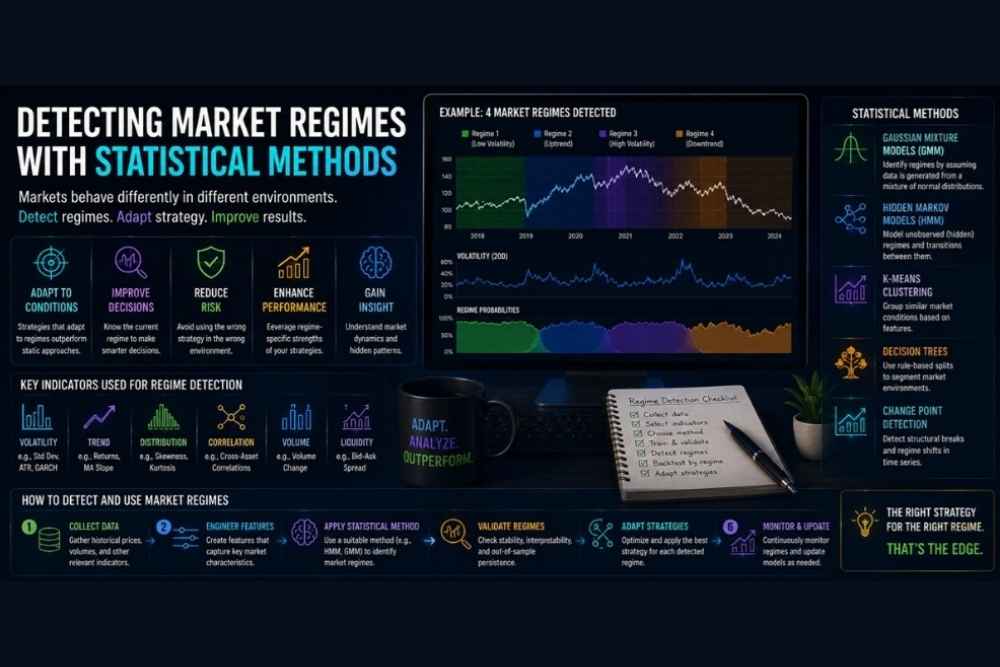
Financial markets rarely behave the same way for extended periods.
A strategy that performs exceptionally well during a strong trend may struggle when markets become range-bound. Systems designed for calm market conditions can experience significant drawdowns when volatility suddenly increases. Asset correlations that appear stable for years may change rapidly during periods of economic uncertainty.
Many traders experience these shifts without fully understanding what is happening.
They often conclude that a strategy has stopped working.
In reality, the strategy may be functioning exactly as designed.
The market environment has changed.
This is where market regime analysis becomes valuable.
Rather than focusing exclusively on price movements, regime detection attempts to identify the broader conditions influencing market behavior and determine when those conditions begin to change.
Markets Are Constantly Evolving
One of the biggest challenges in trading is that markets are not static.
Several factors continuously influence market behavior:
- Investor sentiment changes
- Volatility rises and falls
- Economic conditions improve and deteriorate
- Risk appetite shifts across asset classes
A strategy designed for one environment may struggle in another.
Consider a simple example.
| Trend-Following Strategy Performs Well When | Trend-Following Strategy May Struggle When |
| Markets exhibit strong directional movement | Markets move sideways |
| Momentum remains stable | Reversals become frequent |
| Volatility supports trend continuation | Price action becomes erratic |
The strategy itself has not changed.
The market environment has.
Recognizing these transitions is one of the primary goals of regime detection.
What Is A Market Regime?
A market regime is a period during which market behavior exhibits relatively consistent characteristics.
Common examples include:
| Regime Type | Characteristics |
| Trending Market | Persistent directional movement |
| Range-Bound Market | Prices oscillate within boundaries |
| High-Volatility Market | Large and frequent price swings |
| Low-Volatility Market | Stable price behavior |
| Risk-On Environment | Investors favor growth assets |
| Risk-Off Environment | Investors seek defensive assets |
Markets naturally move between these states over time.
The challenge is identifying when those transitions occur.
Why Regime Detection Matters
Many trading systems implicitly assume that market conditions remain stable.
Real markets rarely behave that way.
This creates a common problem:
A strategy performs well for months or even years, then suddenly begins to underperform.
In many cases, traders attempt to optimize the strategy or replace it entirely.
However, the real issue may be that the strategy was designed for a different market regime.
Understanding the current environment can help traders:
- Improve risk management
- Select appropriate strategies
- Adjust position sizes
- Reduce exposure during unfavorable conditions
In many cases, understanding the environment becomes just as important as understanding the strategy.
Volatility Often Provides The First Clue
One of the simplest forms of regime detection involves monitoring volatility.
Markets tend to alternate between:
- Calm periods
- Transitional periods
- Turbulent periods
For example:
| Market Characteristic | Low Volatility | High Volatility |
| Daily Range | Small | Large |
| Price Swings | Limited | Significant |
| Market Activity | Stable | Elevated |
| Risk Level | Lower | Higher |
These changes often influence how traders manage risk.
A strategy that performs well during stable conditions may require different stop-loss distances, position sizes, or risk controls when volatility increases.
For many quantitative traders, volatility acts as an early warning system that market conditions may be changing.
Trends, Correlations, and Market Structure
Volatility is only one part of the picture.
Many traders also analyze:
- Trend strength
- Market momentum
- Asset correlations
- Liquidity conditions
Consider correlations.
| Normal Market Conditions | Periods of Market Stress |
| Assets often behave independently | Correlations frequently increase |
| Diversification tends to work as expected | Assets may begin moving together |
| Portfolio risk remains more predictable | Portfolio risk can rise unexpectedly |
These shifts can significantly alter portfolio risk and strategy performance.
Monitoring changes in market structure helps traders identify whether the environment remains favorable for their approach.
Economic Regimes Matter Too
Markets are influenced by more than price action alone.
Economic conditions often play an important role in shaping market behavior.
Common economic regimes include:
- Economic expansion
- Economic slowdown
- Recession
- Recovery
Changes in inflation, interest rates, employment, and economic growth frequently influence investor expectations long before those changes become obvious on a chart.
Resources such as the World Economy section and Economic Calendar on MetaTrader.com allow traders to monitor many of these indicators within a single research workflow.
Understanding the economic environment can help explain why market behavior is changing and whether those changes are likely to persist.
Statistical Models And Regime Detection
More advanced approaches rely on formal statistical methods.
Common examples include:
| Method | Purpose |
| Hidden Markov Models (HMMs) | Identify hidden market states |
| Clustering Algorithms | Group similar market conditions |
| Bayesian Models | Update regime probabilities as new data arrives |
| State-Space Models | Model changing market dynamics over time |
The objective of these techniques is not necessarily to predict future prices.
Instead, they attempt to classify the current market environment.
By understanding the current regime, traders can make more informed decisions about strategy selection, risk allocation, and portfolio management.
The Rise Of Adaptive Trading Systems
One of the most practical applications of regime analysis is adaptive trading.
Instead of relying on a single strategy, traders may maintain multiple systems designed for different environments.
For example:
| Market Regime | Strategy Preference |
| Trending Market | Trend Following |
| Range-Bound Market | Mean Reversion |
| High Volatility | Reduced Risk Exposure |
| Low Volatility | Normal Position Sizing |
This approach attempts to align trading behavior with prevailing market conditions.
Rather than forcing one strategy to perform in every environment, traders adapt to the environment itself.
Why Regime Detection Is Difficult
Despite its appeal, regime detection remains one of the most challenging areas of quantitative research.
Several factors complicate the process:
- Delayed recognition
- False signals
- Structural market changes
- Model complexity
- Overfitting
The reality is that market transitions often become obvious only after they have already begun.
For this reason, successful regime analysis is rarely about perfect prediction.
It is about improving awareness and reducing uncertainty.
Building More Adaptive Trading Systems
Financial markets continuously evolve.
Key market characteristics can change over time:
- Volatility rises and falls
- Trends emerge and disappear
- Correlations strengthen and weaken
- Economic conditions fluctuate
Strategies that ignore these dynamics may struggle when market environments change.
Market regime analysis provides a framework for understanding these changes and adapting accordingly.
Rather than assuming that markets always behave the same way, traders can evaluate the characteristics of the current environment and adjust their approach when necessary.
As algorithmic trading, machine learning, and quantitative research continue to evolve, adaptive systems are likely to become increasingly important.
The future may not belong to strategies that predict markets perfectly.
It may belong to strategies that can recognize when the market itself has changed.
Disclaimer: This content is meant to inform and should not be considered financial advice. The views expressed in this article may include the author’s personal opinions and do not represent Times Tabloid’s opinion. Readers are advised to conduct thorough research before making any investment decisions. Any action taken by the reader is strictly at their own risk. Times Tabloid is not responsible for any financial losses.

